Minimalism didn't lose momentum because people suddenly wanted more furniture. It began losing momentum because, somewhere along the way, many minimalist interiors stopped behaving like homes.
Warm minimalism — warm minimalist interior design in its most practical form — is a style that combines the restraint of minimalism with natural materials, layered lighting, and a stronger emphasis on comfort.
For years, the design world rewarded the same visual language: white walls, pale oak, smooth plaster, a sculptural chair, a ceramic table lamp, a carefully placed branch in a ceramic vase. The rooms felt calm, certainly, but often in the way a boutique hotel feels calm: beautiful to look at, less convincing to live in — what designers now call cozy minimalism was the missing half. They optimized for visual quiet, sometimes at the expense of everyday comfort.
Warm minimalism didn't reject those principles. It simply asked them to serve a different purpose.
Instead of wondering how much could be removed, designers began asking a more interesting question:
How little can remain before a room stops feeling generous?
That subtle shift changed far more than the color palette. It changed the role of materials, the way lighting was layered, the kinds of furniture people chose, and even how designers thought about comfort itself. Warm minimalism isn't minimalism softened with beige. It's minimalism designed around the experience of living rather than the appearance of restraint.
Warm Minimalism Isn't About Beige

People often assume warm minimalism is defined by what it looks like. Browse enough interiors labeled with the term and a familiar pattern quickly emerges: creamy walls, pale oak, linen upholstery, travertine tables, handmade ceramics. Those materials appear so consistently in warm minimalist decor that they've become shorthand for the style itself.
But styles are rarely defined by their ingredients.
Mid-century modern isn't really about walnut furniture, just as industrial design isn't ultimately about exposed brick. Those are recognizable expressions of larger ideas. Warm minimalism deserves to be understood the same way.
What distinguishes it isn't the choice of materials but the questions those materials are trying to answer. Traditional minimalism often asked how much could be removed before a room became visually quiet. Warm minimalism asks something more human: What actually makes a room pleasant to inhabit, day after day? Once that becomes the objective, the design decisions begin to change naturally. Light becomes softer because harsh illumination grows tiring. Natural materials — including organic floor lamps built from wood and stone — replace synthetic ones because they continue revealing character over time. Furniture is chosen less for its silhouette than for how comfortably it supports the rituals that give a home its meaning.
Seen this way, the warmth isn't decorative. It's experiential. The room isn't trying to appear cozy; it's trying to make ordinary moments—reading after sunset, sharing dinner, drinking coffee on a quiet morning—feel just a little better than they did before. The aesthetic is simply the visible consequence of those priorities.
The Style Isn't New. The Priorities Are.

Design trends rarely emerge out of nowhere. More often, they arrive as quiet disagreements with whatever came before them.
Warm minimalism is less a new aesthetic than a reaction to the way minimalism gradually came to be practiced. As the style gained popularity, particularly through social media and real estate photography, many interiors became increasingly polished, increasingly restrained, and increasingly interchangeable. The visual language narrowed until the same white walls, pale oak floors, boucle chairs, and carefully curated accessories began appearing regardless of the house they occupied or the people living inside it.
The problem wasn't minimalism itself. Good minimalism has never been about emptiness. It has always been about clarity.
What changed was the purpose.
For a long time, interiors were rewarded for looking universally appealing. Gray walls photographed cleanly. Smooth finishes reflected daylight evenly. Rooms became easier to stage, easier to market, and easier for the next owner to imagine as their own. As we explored in our analysis of America's changing paint preferences, neutrality gradually shifted from being a design decision to becoming a strategy of avoiding one. Homes were increasingly designed to offend nobody rather than delight somebody.
Warm minimalism quietly reverses that logic. It doesn't reject simplicity or ask us to fill our homes with more objects. Instead, it asks whether simplicity has become too detached from the experience of living. That's why warmer palettes, textured materials, softer lighting, and visible craftsmanship have returned together. They're all trying to solve the same problem: not making rooms feel fuller, but making them feel inhabited.
Seen that way, warm minimalism stops looking like another aesthetic trend. It becomes part of a broader movement — sometimes called soft minimalism — toward interiors that prioritize presence over perfection and daily experience over photographic perfection.
Materials Now Carry the Conversation
One of the easiest ways to recognize warm minimalism is to stop looking at the furniture.
Look at the surfaces instead.
Earlier minimalist interiors often depended on contrast: white against black, smooth against smooth, one perfect object inside an otherwise empty room. Warm minimalism asks materials to create interest long before decoration arrives. That's why oak increasingly replaces painted cabinetry. Why limewash has returned after decades of perfectly flat drywall. Why travertine, with its pores, fossils, and irregular movement, has become more desirable than engineered stone designed to eliminate variation. Why hand-thrown ceramics feel more convincing than factory-perfect replicas.
These choices aren't nostalgic.
They're pragmatic.
Objects eventually become familiar. Materials rarely do. Timber continues revealing grain as daylight changes throughout the afternoon — a quality that makes wood floor lamps more interesting the longer they're lived with. Linen behaves differently in winter than it does in summer. Natural stone becomes more interesting the longer you live beside it — a principle shared with organic minimalism — because its variation refuses to become entirely predictable.
Decoration asks to be noticed; good materials quietly reward attention.
That's a more sustainable form of beauty.
Warmth Isn't a Color. It's a Relationship.
One of the reasons warm minimalism is so often misunderstood is that it's frequently reduced to a palette. Scroll through enough inspiration boards and it becomes easy to conclude that the style is simply a collection of creams, oat tones, soft browns, and pale woods.
Those colors certainly appear often, but they aren't what makes a room feel warm. If they were, repainting a white room in mushroom or sand would be enough to transform it. Anyone who has walked into a newly renovated house lit by bright downlights knows it isn't.
Warmth is rarely created by an individual surface. It's created by the way surfaces respond to one another.
An oak cabinet feels richer beside limewashed plaster than beside glossy white lacquer. Travertine reveals more movement when it's surrounded by quieter textures. Linen softens the transition between stone and timber because its weave catches light differently throughout the day. Even metals behave differently depending on what's around them. Brass, for example, feels restrained against natural wood but noticeably more formal when paired with polished marble and high-contrast finishes.
This is one of the reasons designers often talk about "material palettes" rather than color palettes. They aren't simply choosing hues that belong together; they're considering how wood, stone, fabric, metal, and light each influence the perception of the others. A room succeeds not because every element is warm, but because every element allows the next one to become more expressive.
Seen through that lens, warm minimalism stops looking like a preference for beige and starts looking like an exercise in balance. The objective isn't to remove contrast but to soften it, replacing stark transitions with gradual ones and allowing texture, shadow, and natural variation to create the visual richness that decoration once supplied.
The Room Doesn't Feel Warm Until the Sun Goes Down.
People often ask what paint colors create warm minimalism.
Designers usually begin somewhere else.
A room painted in soft mushroom tones can still feel clinical beneath a single bright ceiling fixture, while an otherwise restrained white interior can become unexpectedly inviting once the lighting begins behaving differently after sunset. Warmth isn't applied through color alone. It's created by the relationship between light, material, and shadow, each one changing the way the others are perceived throughout the day.
The same room can feel entirely different after sunset.
Not because the furniture has changed, but because the light has.
This is where warm minimalism quietly separates itself from many contemporary interiors. Rather than treating lighting as the final decorative layer, it treats it as an architectural decision. Timber appears richer beneath warm, directional light than beneath even illumination. Stone reveals movement that harsh downlights tend to flatten. Linen catches soft shadows that give its weave depth instead of washing it away. The materials haven't changed. The light has simply allowed them to become more themselves.
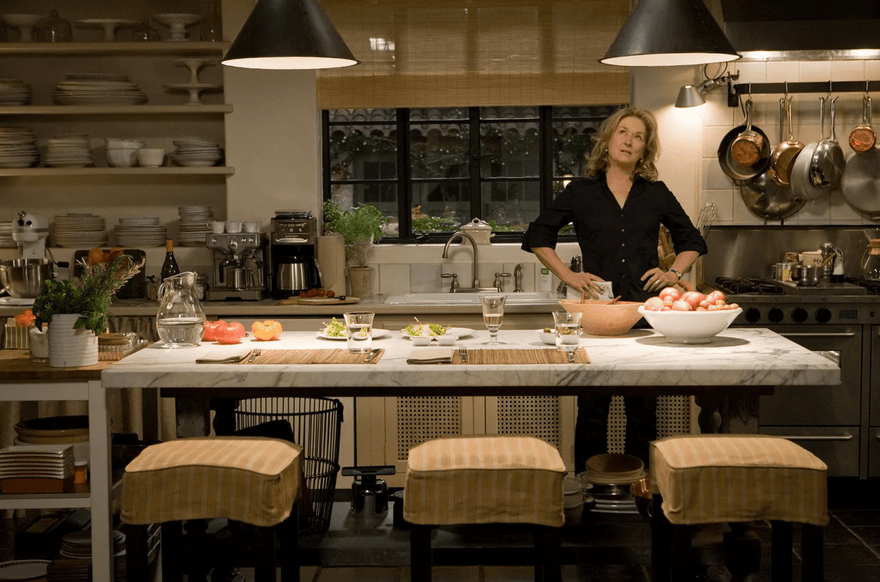
That's why designers rarely rely on a single source of illumination. A reading chair asks for different light than a dining table, just as a kitchen at breakfast behaves differently from a warm minimalist living room after sunset. Layering ambient, task, and accent lighting allows brightness to follow the life of the home instead of remaining fixed to the ceiling.
An alabaster pendant doesn't simply emit light.
It changes its character.
Its crystalline structure diffuses illumination before it reaches the room, softening glare into a glow that feels atmospheric rather than merely functional. It's one of the few materials whose beauty depends as much on what it does as on what it looks like.
Warm minimalist interiors rarely feel dramatic.
They simply make evening feel unusually comfortable.
Texture Quietly Replaced Decoration
Traditional decorating has often relied on accumulation. If a room felt unfinished, the instinct was usually to introduce another object: another framed print, another decorative bowl, another shelf of carefully arranged accessories. Visual richness came from adding things.
Warm minimalism solves the same problem somewhere else entirely.
Rather than asking objects to carry the personality of a room, it asks the architecture itself to become more expressive. Walls acquire the softness of limewash instead of remaining perfectly flat. Timber is selected for the movement of its grain rather than simply its color. Linen curtains wrinkle naturally as they fall, wool catches changing daylight across its fibers, and stone reveals veins, pores, and subtle imperfections that become more noticeable the longer you live with them.
This changes the role decoration plays.
When the surfaces themselves continue rewarding attention, fewer accessories are needed to sustain visual interest. A hand-thrown ceramic bowl no longer has to rescue an empty coffee table because the table's material already contributes something worth looking at. A woven throw isn't there to introduce color so much as another tactile experience. Objects become accents rather than obligations.
That's a surprisingly significant shift because it changes how a room ages.
Rooms built around decoration often feel complete the day they're photographed. Every object has already been arranged, every shelf styled, every corner resolved. Warm minimalist interiors tend to mature more gradually. As natural materials acquire patina, as daylight changes through the seasons, and as daily life leaves small traces on wood, leather, and brass, the room develops a richness that couldn't have been installed on the first day.
Perhaps that's why these interiors often feel calmer without feeling sparse. They aren't asking us to admire what has been added. They're inviting us to notice what was there all along.
Where Warm Minimalism Usually Goes Wrong
Ironically, the easiest way to ruin warm minimalism is by trying too hard to make it warm.
Spend enough time online and you'll begin seeing the same formula repeated endlessly: boucle everywhere, beige walls, pale wood, dried branches, rounded furniture, travertine coffee table. Individually, none of those choices are problematic. Together, they often produce interiors that feel assembled from references rather than built around the people living inside them.
The problem isn't beige. The problem is sameness.
Warmth requires contrast just as much as minimalism requires restraint. A room where every surface sits in the same tonal range eventually becomes visually quiet in the wrong way. Texture loses depth because nothing pushes against it. Stone stops standing out because everything nearby behaves similarly. Even beautiful materials become strangely forgettable when every object speaks at exactly the same volume.
The strongest warm minimalist interiors almost always contain tension.
Warm Minimalism Is Designed to Improve With Time
One of the quiet assumptions behind most decorating is that a room reaches its best version the day it's completed. From that point onward, the goal is simply to preserve it. Warm minimalism begins from the opposite premise. It assumes that the best interiors are never entirely finished because the people who inhabit them become part of the design itself. Floors acquire a familiar patina along well-traveled paths, linen softens after countless washings, brass remembers the places it has been touched, and timber develops a depth that wasn't present when it first arrived. Rather than treating those changes as signs of wear, the style treats them as evidence that the room is fulfilling its purpose.
That may be the movement's most enduring idea. Good interiors shouldn't peak on installation day. Like good architecture, they should become more convincing through use, rewarding the ordinary routines that no photograph can fully capture.
Furniture Stops Filling Rooms and Starts Shaping Them
Architecture determines how we move through a building. Furniture determines how we live inside it.
Warm minimalism treats that distinction with unusual seriousness. Rather than filling rooms until they appear complete, it asks each piece to justify the space it occupies through use as much as appearance. A dining table should encourage people to linger after dinner. An armchair should make reading feel more inviting than reaching for a phone — in a warm minimalist bedroom, it often becomes the most-used object in the room. A sofa isn't simply balancing the proportions of a room; it's deciding whether conversation happens comfortably at all. Once furniture is understood as something that shapes behavior rather than merely completes a composition, choosing less begins to feel less like restraint and more like precision.
That's why the style favors enduring forms over fashionable ones. A well-proportioned chair doesn't become obsolete because another silhouette replaces it on social media, and a solid timber table remains satisfying long after the trend that introduced it has passed.
The best furniture eventually disappears.
Not because it lacks character, but because it becomes so naturally woven into daily life that it's noticed less as an object than as part of how the home simply works.
You Don't Need to Start Over
One of the reasons warm minimalism has become so widely adopted is that it rarely begins with a renovation. Designers seldom walk into a house intending to replace everything they see. More often, they start by asking a simpler question: What feels louder than it needs to be?
Sometimes the answer is harsh lighting that flattens every surface. Sometimes it's an excess of competing finishes, or shelves filled with objects that no longer contribute much beyond occupying space. Warm minimalism isn't created by introducing a new aesthetic all at once. It usually emerges through a gradual process of editing, allowing the architecture and materials to carry more of the visual conversation.
That shift naturally changes where designers focus their attention. Rather than chasing a checklist of "warm minimalist" products, they tend to prioritize decisions that reshape how the room is experienced every day:
- Layer the lighting — a minimalist floor lamp in a reading corner often does more than a fresh coat of paint — before changing the color palette. A room often feels warmer because the evening has changed, not because the walls have.
- Upgrade the materials people interact with most. A solid timber dining table or a brass door handle — the foundations of a warm minimalist kitchen or dining space — will influence daily life far more than another decorative accessory.
- Reduce visual competition. Removing three objects can have a greater impact than buying one more.
- Let texture do the work of decoration. Linen, wool, natural stone, and timber continue rewarding attention long after decorative trends begin to fade.
None of these changes are especially dramatic in isolation. Together, however, they begin shifting the atmosphere of a home in ways that expensive renovations often fail to achieve. That's because warm minimalism isn't built through a shopping spree. It develops through a series of better decisions, each one making the next feel a little more obvious.
Who Warm Minimalism Is—and Isn't—for
Spend a few minutes inside a genuinely warm minimalist home and something unusual becomes apparent. There often isn't much to look at, at least not in the conventional sense. There are no shelves demanding attention, no collection competing with the architecture, no constant invitation to admire another carefully styled corner. And yet the room rarely feels empty. You begin noticing other things instead: the way morning light moves across a plaster wall, how the dining table becomes the center of the evening almost without trying, or how a favorite chair gradually becomes the place where every conversation, book, or cup of coffee seems to end up.
Some people find that deeply satisfying. Others find it unfinished.
That's probably the simplest way to understand who warm minimalism is for. It appeals to people who enjoy living with fewer, better things—not because they admire restraint as an idea, but because they enjoy paying closer attention to what remains. If collecting, displaying, and layering objects is what gives a home its character, another style may feel more natural. Warm minimalism simply places that character somewhere else. It asks the architecture, the materials, and the quality of light to do more of the talking.
Not less personality.
Less distraction.
Those aren't the same thing.
Bringing Warm Minimalism Into Your Home
Warm minimalism isn't difficult because the furniture is expensive.
It's difficult because every decision becomes more visible.
When a room contains fewer objects, proportion matters more. Materials matter more. Light matters more. One poorly chosen chair has nowhere to hide. One beautiful piece of stone suddenly influences everything surrounding it.
That's precisely why the style often rewards patience.
Rather than filling a room quickly, it encourages waiting until the right object appears. A well-crafted pendant that transforms evening light. A dining table that improves with age. Cabinet hardware that develops character instead of wearing out. Materials chosen because they're satisfying to live with, not because they're currently fashionable.
It's no coincidence that many of the materials associated with warm minimalism reward use rather than novelty.
Residence Supply's collections naturally align with this philosophy for exactly that reason. Whether it's handcrafted alabaster lighting that softens illumination, solid brass hardware that records years of daily use, or fixtures built around honest materials instead of imitation finishes, the products aren't there to decorate minimalism.
They're there to give restraint something worth revealing.
Warm Minimalism Was Never About Beige
Warm minimalism is often reduced to its visual language: oak, linen, travertine, muted earth tones, handmade ceramics. Those materials matter, but they're only the visible expression of a much quieter idea. At its core, the style isn't trying to make homes look warmer. It's trying to make them feel more generous—to replace visual perfection with material honesty, and decoration with atmosphere.
Perhaps that's why the style has resonated so widely. Beyond the colors and the furniture lies a simple shift in perspective: a home isn't successful because it photographs beautifully on the day it's finished, but because it continues rewarding the people who live there long after the novelty has faded. Trends eventually become dated. That kind of generosity rarely does.
Warm minimalism isn't asking us to own less.
It's asking us to notice more.